Episode Transcript
[00:00:00] Speaker A: It just changes the narrative around budget into outcomes, which I like to say, people are not buying lumens, they're buying outcomes. The cases that don't sell are not properly illuminated. There's this incredible dumpling restaurant. The food is incredible. I only get takeout. And here's why. Because lighting. Lighting is horrible. Your lighting team, whether they are embedded in your electrical engineering firm or whether they are an outside participant, they have to be in the visioning session, period.
[00:00:36] Speaker B: Welcome to the podcast about Lighting Matters. Our unflinching conversations uncover the nuances and complexities which shape the craft of lighting design.
[00:00:45] Speaker C: We explore the pivotal whys behind a lighting designer's choices and find honest answers to your most challenging lighting questions. Because lighting matters.
Hi, and welcome to the Lighting Matters podcast. We're so excited about our conversation today.
I'm Lisa Reed with Reed Burkett Lighting Design, and I'm here with my co host.
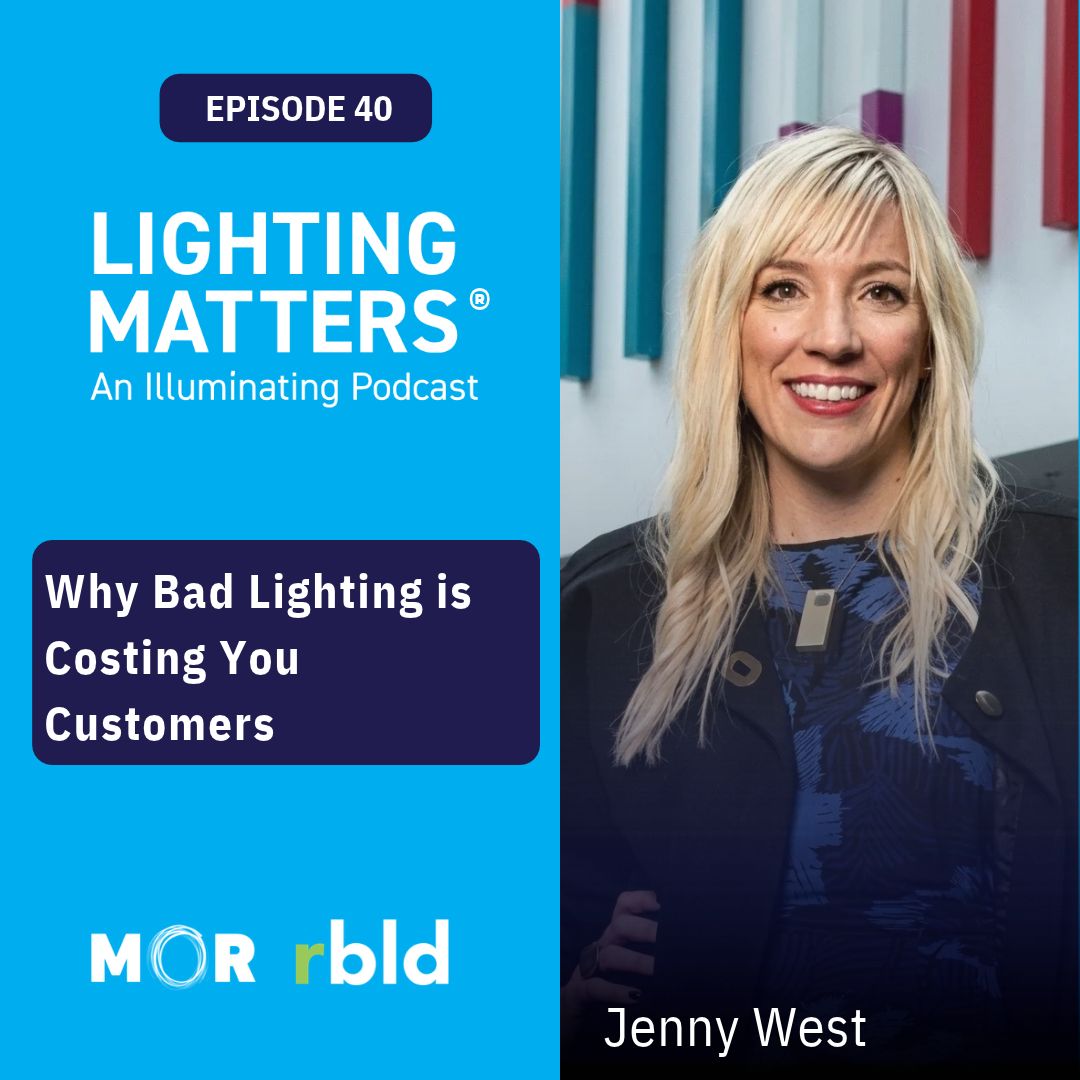
[00:01:11] Speaker B: Hi, everybody. Avi Moore with Morlights and so excited to continue on or start anew with Jenny West. Jenny was part of the panel that Lisa and I were on at Neocon, and Jenny's so excited to have you on the Lighting Matters podcast today.
[00:01:33] Speaker A: Thank you. I'm thrilled to be here. And again, it means a lot you reached out after Neocon. We had a pretty dynamic panel at Neocon. Maybe in the show notes we can add that YouTube as well. And it was something, I think we all agreed we should continue this dialogue. So happy to do that today.
[00:01:51] Speaker B: Yes, very much so. And how we continue it next year's Neocon, which is now, let's see, this is end of August that we're recording. So eight months away from Neocon next year.
So, Jenny, just for the audience, will you share a little bit about your background and what inspired your path?
[00:02:14] Speaker A: Well, my journey started as an interior architect at Gensler. I went to Kansas State University, did interior architecture.
[00:02:23] Speaker B: I forgot you went to K State. We're 2K viewers over here.
This podcast episode.
No, we're good.
[00:02:31] Speaker A: Let's start over.
Well, I will admit that I married a Jayhawk, so I have a house divided. And all of our family is Kuk State. That's just a great betting opportunity.
[00:02:45] Speaker B: Yeah, I mean, purple and blue and red, they just collide.
[00:02:51] Speaker A: They just collide. Yes, well, and having a kiddo that's about ready to look at colleges, boy, the fire has started. So.
But I loved K State, the interior architecture program, you know, at the time, and I think still now is one of the most premier programs you can go to. And I loved it because I also tapped this interest of making art and furniture and products in the wood shop as well as learning structural engineering and in electrical and all of the different architectural systems that make interior design possible. So yes. So okay, K State and then went to Gensler and became a licensed interior designer. I quickly was attracted to this career in workplace strategy and moved over and worked at Knoll and consulted on the west coast for several years for a lot of different Fortune ones. My, my passion there was, was really like that. I was curious about how do you take one great project and then cascade that across a portfolio in a way that feels right for the region, you know, also is easy to track and make sense of the total portfolio. So I've really been an expert in change management and workplace strategy and planning on a macro scale and how do you scale up and down across decisions and keep evolving. So you know, thought leadership, reading, writing, education. I'm really intrigued by what's next. I'm always curious looking around the corner, what's about, you know, what's about to come at these companies who have these assets that need to stay contemporary, including changes in workforce. So with that big history, I also led a national project management group for CRESA and we'll talk about that maybe in a minute. The parallel lives between project management as a profession and in lighting design as a profession. But currently I work for myself for the first time in 20 years.
It's been two years in the making and I can tell you more about some really exciting projects, big and small, including fine art that I'm working on right now. So it's been a great, a great journey and obviously every day is really different.
[00:05:14] Speaker C: That's one of the things that I appreciated on our panel is that you have a different perspective than certainly than the lighting designers, but also the change management and the project managers, just all of it. You come, you have such a great background for looking at things differently and you are so clear eyed and your messaging is so clear.
Something that we need in the lighting industry.
[00:05:39] Speaker A: I mean, tell me more. I think that part of what I've done at every brand, it's about understanding what service or product are we offering and how does that benefit the end user. The wonderful, I would say part about lighting is that people in the technical side, we jump to just the technical parts and, and the cost and the quantity and the candles and all of that. But the client still has to be brought along to understand, hey, this will help your people avoid getting migraines during the day or this will Help your people change their mood and align the task to the environment. And those I think are probably systemically the things and the language we need to add in our lexicon to ensure clients understand the value of the service and the profession. But yes, Lisa, wide variety. I'm a very curious person and having been at every side of the table pretty literally, you know, we're either representing a client or being the specifier, or now as an artist and complementing architects visions or designing projects. You know, that, that variety I think never gets old, that's for sure.
[00:06:59] Speaker B: Do you still work in the wood shop? Do you have a shop in the house or.
[00:07:04] Speaker A: Yeah, well, I have a 1966 mid mod house and we are constantly working on it. It's a constant. What project are we fine tuning? So I love working on my, my own projects and, and then in terms of art. Well, I mean, just to take us back a little bit, I grew up like under the hood of a, you know, classic car all the time. Like my dad restored old Chevelles and in fact we have a 69 Chevelle that he fully restored. And I've always been a gearhead. Like we have a 69 Bronco and we just love. I love automotive design and I think I just inherently like grew up at junkyards and, and seeing the transformation of something that we literally pulled out of a ditch into a $170,000 car. You know, like, it's like, wow. You can literally take something and make it, you know, so beautiful. So I love that transformation and I'm always in have a high regard for those that understand electricity and motors and engines and then like the grit it takes to do that. So yes, I have lots of tools and like doing things currently actually collaborating with a fabricator to make some new sculptures in a product line that I am very excited about. Maybe I can share that in like a month when it's done. But yeah, I. While I don't weld, I work with fabricators. Lots of different materials all the time.
[00:08:35] Speaker C: So go ahead and tell us specifically about what you.
Your business right now and what you're, what you're doing. Go ahead and plug market away.
[00:08:45] Speaker B: Plug away, sure.
[00:08:47] Speaker A: Okay.
Well, I created West Consulting because of the variety of services that I offer. Currently I am designing a jewelry store.
I am coaching some sales teams on value articulation to better their client experience.
I'm working with a large aviation brand to better diagnose the user journey and user experience milestones to enhance fluidity from point A to point Z.
And lastly, I'm self investing in producing a new gallery show and currently moved into an artist in residency right across from the Denver Art Museum for about nine months and am currently working on a few commissions that I have under wraps with a variety of, of mediums, all site specific art commissions. So really what's, I would say when I tell people the variety of work I do, they're like, oh, wow, how do you, you know, how does that work? But truly it's, it's a gift and a, it's a privilege to be able to. Yes. Design space or design that art piece that goes in the space or really coach the client on what the customer's going to experience through the space. So I really have always loved that intersection of not just with this, I guess that's the story arc of my career is like it's not just what the space or the thing is going to look like, but how will people feel and what will people really take away as a story from experiencing that space? And that's the, that's my favorite part.
[00:10:28] Speaker B: It's so interesting. You talk about the experience, right?
Just yesterday was on a phone call about a project and somebody, the architecture team was just like, well, what if we add a light here and what if we add a light here? What if we do this, what if we do that? It's like, wait, wait, wait, timeout. What are we trying to do? What's the story? What is the element? I mean, in my head I'm kind of a little bit thinking, well, how do I explain how we've designed this space and 10 years in press or whatever it may be. But the other side of it is why are we just doing this?
What, why are you, why have you moved to the technology instantly? Like, take a step back. What is the experience? What is the story? What is the language? Why architect have you done this? This is not inexpensive what you've designed.
And then you're talking about lighting technology on top of it versus going to the experience, going to the story. What is going to happen?
It just, it baffles me and it baffles me that the lighting designer, you know, in me is the one bringing this up to this architecture team. This isn't new architecture team, this is.
[00:11:46] Speaker A: Oh yeah, okay, let me break this down a little bit. Yeah, bring it up.
I think there's an industry wide change that needs to happen.
Your lighting team, whether they are embedded in your electrical engineering firm or whether they are an outside participant, they have to be in the visioning session, period, right? Like hearing it straight from the client.
What makes most sense to.
To accomplish out of the space? What's most important?
What are some of the ways you'll know that this space is successful? What are the things people will say? What are the, you know, headlines from the future? That's the old thing we used to say, but, you know, having your teen lighting designers understand the vision and the outcomes and what you could, what could you hold in your hand that is an outcome everyone agrees. Wow, that worked. I think that would solve a lot of this all. A lot, a lot of these challenges like being brought on at, you know, end of DD and saying, whoops, we're at. We have a budget bust and we suddenly need someone, you know, that's a, that's the wrong sequence. And I think we all understand that, you know, you can't like jump in the ship and plug the hole, right? Like it's, it's a onboarding sooner and being more integrated in the client vision moment, you know, how do you want people to feel in here? If there was one major super moment, what is it and why? And it could be this. I worked with a really cool manufacturer up in Fort Collins, and they had all of these incredible little prototypes that talked about the number of patents that they've issued over the years.
And they were just sitting in the corner in a dusty box while, you know, illustrating the timeline and breadth and ingenuity of, of a long, their long history.
When people say, hey, we hit 50 years, you know, instead of a big vinyl logo on the wall that says 50, you know, you could truly show the patents that you originated over time. And I mean, talk about ideal. Like dream project is like a time timeline wall with different artifacts and things.
But, you know, bringing that to life through lighting. It might be the thing the client needs, but doesn't know how to say in the beginning.
[00:14:15] Speaker C: I think that is so true and it's so important because we do want to be part of telling the story.
And then there's budget pressure because between that visioning session and DD are a bunch of iterations that maybe lighting doesn't have to be a part of because we respond to the architecture. Yeah, I don't know. You're making me think about, let's be there at the very beginning. But then, you know, we can step back while you iterate.
We can iterate with you. It's fun, but it's sometimes that creates some budget pressure on the design fee side.
[00:14:52] Speaker B: I wonder if there is a way to think of it in the theater Right. It's hard to bring a lighting designer in before there's a draft script. But in developing the script, the final script, there are lighting elements that usually go into a well crafted script draft. Right.
Then you have to go away and run the script through its paces. Right. See if the interaction between the actors makes sense. Is there a comedic pause that isn't playing, so on and so forth. But then the set designer has to go build the set, the costume designer has to develop the costumes. There's a lot of elements in the sonography of a show that need to be developed. And then the lighting designer comes in and sees all of those elements, puts together their elements, sometime pushes back. Some of you on the podcast have heard before, like, what color black is that black costume? Right.
Are you going to dye that black or are you gonna get a pure black? Right. Cause there's red blacks and blue blacks. And I mean, I got a drawer of colors from Sherwin Williams of blacks. And then only when the show is in tech rehearsals do you really find that true interaction.
So I guess what I'm kind of connecting this to a little bit in our architecture world is that initial creative needs that initial story.
We are going to do Macbeth at a carnival. Great. Macbeth at a carnival, which I'd love to see. I think that'd be interesting. Okay, so then everybody kind of has that idea. And then from there you figure out the gist of the carnival and what parts of the carnival are going to play in and where certain scenes are going to play out. And then the lighting comes back in to make it happen. Right. Same thing comes true with architecture. Right. What is the story? We are going to build a 50 story high rise office space with a primary tenant of Frank's Hot Dogs. Okay, great. So that means the lobby needs this kind of feel. Great. Go forth, make that work a little bit. We understand we should have a lighting element because Frank likes a lot of neon because that's what's in all of his storefronts. Okay.
[00:17:18] Speaker A: Frank's Franks. Is that who we're talking about?
[00:17:21] Speaker B: Yeah. Or actually, I just saw the history of blockbuster, so maybe that's a better example. Right. The blue and the yellows. So we know blue and yellow. Very themed, very on target. We get that. Okay, go forth architecture and interiors team, figure out how you're going to apply the blues and the yellows and all that stuff. And we'll come back once you've had a few ideas and kind of formalize some of that. But we understand that color rendering of Those colors because Blockbuster's blue and Blockbuster's yellow was really important.
And the other piece is that we can help define budget. Right. You're not going to be able to go to a home center to buy light bulbs to make sure we render those colors appropriate. Right. I think there's something. And it just, it's all too often that in the lighting, architectural lighting world, we kind of forget about the theater theatrical roots to this.
[00:18:22] Speaker A: You know, I think you're onto something there. And I feel like it could be a book deal for you very easily.
And what I mean is maybe a playbook, right? Like, hey, this is a manifesto on how like we could parallel an industry that's got it dialed in, right.
You have the transcript, you have the costumes. You know, I, I could see this really being almost a mirror type of playbook to say, okay, now we have the vision of this company. We know what is what people are doing in the variety of spaces. We have our priority, big moments for customer experience.
And now we know how to prioritize the budget, create the mood we're intending for and then obviously not leave everything else in blight, but do what you can for the rest of it, you know, And I think it's, it's come a really long way in terms of that, the activity based planning and the zones. And I think every designer is understanding the connotation of function and mood throughout the workday. You know, we do need different settings throughout the day.
And I think lighting design, that's why it's become much more, you know, widely demanded and understood because it's hard to get that out of a strip light and some two by fours. Right. So even in, you know, some workspaces I've personally been in or and are in now, they're overlit. They're really overlit. And the color rendering is really difficult as an artist to, to handle. So, you know, I think you're onto something there. That's your book deal. Consider me your agent.
[00:20:07] Speaker B: Well, and there's, there's an interesting. I just want to throw this out there so it's recorded in the ether. But there's also an interesting financial model in the theater too. Right. Lighting designers and set designers get paid a fee to design the show and then they get a percentage of the door in perpetuity.
So if a show flops, it's done. Right. Like the show doesn't, a show doesn't last long on Broadway or wherever else you lose out. Right. And the Broadway structure. Right.
[00:20:41] Speaker A: Okay, so let's push this further when this company's stock soars and they're retaining staff longer and acquiring talent and clients quicker. Are you saying you have this commission structure that's a brilliant idea?
[00:20:57] Speaker B: Absolutely. And I mean there'd be some risk in it, right? Like you can't have the reward without a little bit of risk. So you know, you'd have to have lower money up front with money coming every year.
But you know, that, that's how the, that's how I otsi the union for lighting designers and set designers ultimately negotiated with the producers. And I'm not an IATSE member, but it's my understanding, you know, there's a model there that could be very interesting instead of what happens right now is 0% interest free loans, definitely not a massive profit center. I mean we, we make profits. But anyway, I don't want to go down this road. But it's an interesting, like extension could be interesting.
[00:21:46] Speaker C: Well, it's, it's interesting because it's saying, hey, I believe in this thing that we're the service that we're providing you. So much so that I'm willing to delay gratification because I know it's going to benefit you this much, it's going to benefit you financially. And I'll wait and take my cut when you see how valuable what we've provided is to you.
[00:22:06] Speaker A: Well, there are fee structures out there like this integrated project delivery ipd. It's been done in the past where, you know, milestones met and timeliness renders a bonus or certain percentages are held back and until outcomes are delivered as such and if there's accelerated delivery or exceeding this, there are other incentives. So there it, it could be out there. I'd call that, you know, in a nutshell, like some of the two areas that lighting design as an industry needs to, needs to address and give people that playbook and toolkit of, you know, how do we get hired from the get, how do we get included in the vision earlier? And what is that value proposition that ties uniquely to a customer? Like I'll give you a really hand in, in my hand example. So currently designing a jewelry store and as you know, jewelry needs to sparkle and there are years of data and observational data around what existing cases sell and which cases don't. And really flat answer that cases that don't sell are not properly illuminated. Yes, it is really simple.
So that's a case in point, pun intended, that you know, you light those babies up and there goes your sales. So you know, I think the value proposition for a jewelry store is really clear. You can kind of say, okay, that's, that's well lit, it's selling, it's this or that.
Then when you think about, say, I'm talking to someone in HR that has 3,000 employees in an office, there could be other quantifiable results that they can put their arms around. And sometimes it's around sick days, sometimes it's around the number of folks asking for an extra ask lamp. Or you walk around and there's a quadrant of the building with their lights off notoriously. Or you've got some group fighting over the shades all the time, right? Or, hey, there's this glare death ray coming in at a certain time of day, and we have no tools to protect ourselves. So we have this cardboard fort. Everyone has a piece of cardboard, and we're literally trying not to get burnt on a zoom call in the office. And these are all very, very real scenarios. But the key is, you know, we have a lot of work as an industry to relate the value to what matters most to that certain client. And it is, it's very much a tailoring task.
[00:24:56] Speaker C: Yes. And our challenges as an industry, we don't have maybe scientific research on all of those things. We have a lot of anecdotes. And I guess I would ask you, with your experience and skill set, you know, can we promote lighting on those anecdotes, on those stories, or does it have to be quantified and monetized?
[00:25:16] Speaker A: I think stories from real examples, you know, I. It would be powerful, right? But capturing what can be at risk when, when things aren't thoughtful or when things aren't. Aren't planned ahead, capturing that risk is okay, could be a change order. You know, it could be, hey, we have a have and have not kind of culture or, you know, I think I told you at Nikon, I used to have a really bad chronic migraine issue. And I kind of deduced, I think it's triggered by over lit fluorescent lights. And I was just grinding at an architecture firm under a fluorescent light all day. You know, it kind of was one of the, I would say one of the factors. So I understand sensory and lighting issues now a lot better, but I think anecdotes are okay. There are also quite a few research studies out there that maybe it's about creating a repository of the studies that do exist.
For example, what color rendering and lighting levels inspire creativity, which lighting levels inspire decision making, faster decision making, which color lighting strategies reduce stress and cortisol. Those There are a lot of studies out there, and so I think it probably is a mix.
[00:26:39] Speaker C: Lisa, I happen to be having lunch today with a researcher who's got a. She. She's done research extensively in aging, but also in lighting and its impact on migraineurs. So if you have any questions you want me to take to her, I'll get back to you.
[00:26:57] Speaker A: I would, I think, I think that's a fascinating area of focus and generational preferences and actually, you know, the acquired disability we get, I mean, I, I had now have an astigmatism and you know, it's, it's like kind of a, a scalable issue that, you know, we do need more light as we age and that's why having levels and choice is really important. But those workers that have equipment at their desk and that's their primary space to do their work, it's hard to untether from it.
That's when the conversation is, okay. If there's not a lot of mobility at the desk and you have this, you know, five generations in the workplace, we have to have some individual modalities at the desk because otherwise people are going to have, you know, sick days and lots of different questions. Right, sure.
[00:27:53] Speaker C: Choice is such a, such a big one and maybe easier than we think.
[00:27:58] Speaker A: Are you seeing a lot of people requesting sensors and personalization as a trend, or do we have a little farther way to go?
[00:28:06] Speaker C: I mean, there are so many limitations with just codes, energy codes and things on sensors and controls. I don't know. I don't feel like it's a recent trend. I feel like it's something that I see, saw and heard about more earlier in my career.
[00:28:20] Speaker B: Yeah, I feel like it's kind of dissipated a little bit of that personal control. I know we did a project years ago where we worked to try and get personal control down to the IP phone. Right. Because IP phones basically have a web server in them so you could give personal control based on area via the phone, IP commands back into the lighting control and back it was in the spec. We bid it that way only to discover that this corporation decided to move all their servers to a server farm outside of the office location so that then the lighting control would then have to speak to offsite. Like it just turned into a extremely complex IT problem and it died at the doorstep. I mean, it was part of the spec, totally wanted to happen, but because the lighting control system would require a server that would then speak to other servers and the IT team did not want to manage an on premises Server, they wanted everything remote. It fell apart. Right. So there is a technology problem to make that work. Right. And we're not going to add all these keypads. I mean, that just seems crazy and such. What's interesting about what we're talking about here is and where I was kind of thinking that the realist in me is with producing this information.
Right.
It would seem to me welcome you to say no, but the people who would win the most, not only, you know, the end result obviously is for our clients. Right. But the goal of having this information out there would be to elevate the professional lighting design.
And so by having this kind of information out there, it would best benefit lighting designers as opposed to the manufacturers. Because a manufacturer's gonna wanna push that their products create this benefit.
But what we're talking about is that design disconnected from the product is what elevated and what helps with these solutions.
And I think that it only benefits. The end benefit would come to lighting designers. It benefits our clients and all of that in the end. But to have this research available to, to have these antidotes, to have these stories and a place for it to live to then be pushed out should be some organization that represents the professional lighting design is, is what I was trying to process here. Sorry. It's a long way of saying, yeah,
[00:31:07] Speaker A: I think you're spot on. And as someone that worked in the furniture industry, we had a communal understanding that yes, there may be a manufacturer's report that says some arrangement of furniture enhances collaboration. Let's say that. I mean hypothetical or empowers well being.
And a lot of people say that about that. And I think as designers we know, yes, thank you for putting that in a thought leadership package with a bow on it that everyone says, aha, I get, I get that and see that. But we also realize it can't just be their chair that's doing it. Right. But we associate the brilliance and the ingenuity and ideas with that brand and obviously reward them, you know, those that, that guide us to stay contemporary in a big way. But it is, you know, I think it's shared knowledge that there, there is a communal factor to it. Yeah. Which is, I think, I think what I'm saying is I agree with you.
[00:32:09] Speaker B: So in that furniture example, is there like a furniture group that would then like say manufacture A, B and C, all kind of release their own versions of this is what enhanced creativity with our equipment? Is there a furniture then group that says, well, you know, we've kind of seen these three things and three different manufacturers say this. Why don't we combine those together, remove the specifics from the manufacturers and say, hey, look, we as an association of furniture manufacturers say this is what we believe will improve collaboration. And by the way, here's three specific manufacturers versions of this. Does that exist?
[00:32:57] Speaker A: So while I'm tempted to point out a couple things, I feel like, you know, Amanda Schneider would be one. She canvases national suppliers, synthesizes reports. I think that that's one person that comes to mind that does a nice job with the thought leadership. There's Workplace Evolutionaries, which is another group that I've seen amalgamate lots of different sources into a trending theme. But I would say a lot of great design firms and the consulting practices within those firms, they notice, okay, I've seen this from these four different sources. And then they use that to generate their own point of view.
So I don't know if it's like IIDA or ASID or other places that have such a point of view report, but there are definitely blogs and places that, that say, you know, here are these four recent articles about say, neurodiverse, Neurodiverse strategies, therefore interiors. Take note, this is important. This is coming. These are areas of specialization that can help you win projects. So, yeah, I do think that's important. And like, okay, let's bring it back to the lighting industry.
Is there someone that is that center of knowledge? I mean, I'd argue podcasts like this bring to light a lot of the, you know, the chatter that's out there and, and reinforce it and share it out. But I haven't quite seen a blog in as such. But, you know, great recent example was, you know, the Illuminate series at Neocon that was produced like, I loved what Sohana and you did with that space and the education that I took away from, you know, people wondering if there's some kind of wall washer versus a graze. I was like, oh man, that vocabulary has been interchanged for as long as I've been in the profession. So thank you for correcting some vocab for folks. But, you know, Neocon should be an opportunity to have that net cast and bring back, hey, here's the voice of the market. And here are the things from product innovation, but also delivery that is enhancing us all as, as a profession.
[00:35:21] Speaker B: What I'm kind of pulling from this because, Lisa, you and I have talked about elevating the professional lighting design and, and such, but also having an independent body thought leadership group, right? That is not Lisa, rbld, Avi, Morlights so on and so forth. But like that thought leadership coming from whatever it may be as to what's going on. And honestly, I think the best one going on right now is the. And I have referenced this multiple times on the podcast, and I should really just have it sitting on my desk. Which is the IES recommended practice for physically affecting people. Right. It's the first standard. It's not a standard recommended practice that the IES has released that does not have anything to do with light level, quantity and everything to do with exposure to light and color and everything else. And that is amalgamation of research.
Right. It came from a. From other documentation that IES put together. This is then released as a. Hey, lighting practitioners, this is what you should do. So in a way, I guess we kind of have the IES as our voice to release recommended practices on how we should move forward. But I think there is this other element of, you know, well, being, health, you know, that the cardboard story is so great. Right?
[00:36:51] Speaker C: Yeah.
[00:36:51] Speaker B: I mean, we see that. We've seen that they're fighting over the shades or not paying attention to, as I like to say, luminaire number one, how much sunlight's actually coming in. That I think is important. And that's not an ies. I think it is anecdotes with a little bit of research. And that's not an IES place to be. The IES is illuminating engineering society.
[00:37:17] Speaker C: Yeah.
[00:37:18] Speaker A: And I appreciate you posted that. And I actually took a spin in there and looked at.
I thought it was a really incredible reference for practitioners that they should read and know.
Absolutely. But like, Lisa, I think like you said earlier, are stories more powerful or are facts more powerful? And that's just the human nature of influence, frankly. You know, we're talking about how do we influence customers? And when, you know, when the technical prowess is sound, then it's about articulating value or talking about intention and vision.
And that's the art of influence here. So I like the idea of engaging, you know, possibly a futurist who can take those patterns and associate a theme for the industry and have that type of vision in the future, and that there are lots of people that would be appropriate. I mean, I'd love a research project like that too, personally. But, you know, pattern spotting and then in really having that report, it's almost like the color forecast for the color industry or projecting design trends, you know, they're all somewhat nuanced, but bringing together and like, okay, landing the plane to actual stories that, hey, we see this happening and it's backed by this cognitive report from IES that that's what needs to happen. How can we do that?
[00:38:55] Speaker C: And different, different parts of that are going to land with different people. You know, some, some humans are going to want to hear the story and others are going to want just the facts. Just the facts, man.
So I guess then knowing that, and I'm sure that you're sensitive to your client and who they are and what they want to hear from you, first of all, I guess, do you talk to clients about lighting or lighting design? And then assuming you do, how do you talk to them about lighting as part of the bigger picture of everything that you're doing?
[00:39:30] Speaker A: Yes, we talk about lighting. I would say when I have a really budget sensitive customer, it's a whole different game.
And not to say good lighting can't happen on a budget, but there are a couple of instances where we have a budget, budget friendly customer that is just like, we can't, or hey, we can't pull a permit on this particular scope. We need to, you know, just make it a finished style. You know, those are really different than say a client who has a lobby of a major hotel brand. You know, they would understand and have a different appetite for having lighting design professionals in part embedded in the team. And I, So I have to be sensitive to who I'm speaking to.
But I will say, even, you know, the budget friendly projects, I always try to get a priority upgrade out of it. You know, there has to be like some, some wow factor somewhere. That's really well done.
What is it? Why? And making sure that that's done really well is the way I would, I would speak to it. But in, in general, the like, I think you're asking about the business case, right? Like, how do I speak to it? I like to understand what does poor lighting cost you? You know, not what does good lighting cost, but what if the lighting is poor? What does that cost you? And that could be, for example, jewelry that isn't selling well. You know, let's field up. Field. Observe.
[00:41:06] Speaker C: Aha.
[00:41:07] Speaker A: It's poorly lit. It's not in a main traffic area.
That is a true cost. You could, you can literally compare like sales.
Now I can literally, you know, ask, is there absenteeism correlated with, you know, migraines or lighting? Are there popular areas of your existing space? Why do we think that is? Oh, because we can see trees. It's beautifully daylit. We love the library. We all have these little tasks, Glamps. It's moody, you know. So I think what drives me in a effective client conversation about lighting would be understanding the risks of having poor light because it helps me understand. Aha. Okay. That's really important to them.
And then it just changes the narrative around budget into outcomes, which I like to say people are not buying lumens, they're really buying. They're buying outcomes.
[00:42:09] Speaker B: Well, and it goes back to what we were saying before with understanding the story you're trying to create. Right. You're doing the research of the existing.
You're trying to create the story going forward.
And to know the story you want to create, you have to see the existing and without paying attention to the light in some way. I mean, Lisa and I talk about a lot that bad lighting, everybody understands real quick. But good lighting, best thing about good lighting is nobody talks about it because it just works. And you're talking about the experience and everything else. Right, right. So, you know, again, it's about getting people to actually think about it a lot. About light, but not about light. Right. About the experience.
And then there's smart people like Eugenie and us that can say, well, let me reverse engineer to get back to a technical thing.
The feeling that you are talking about.
[00:43:12] Speaker A: Yes, exactly. Like there. Okay. There's this incredible dumpling restaurant in, in our neighborhood. The food is incredible. I only get takeout. And here's why. Because lighting, the lighting is horrible. Also the chairs. But so, you know, I, I bet you if, if designers and folks in our group are listening, you know what I'm talking about. You know, the restaurants that are like either way too loud or way too over lit or horribly dense and uncomfortable or has no pizzazz. It's like no matter how good those dumplings are, we are going to sacrifice clients that want to spend time there. Right. So that is such a important piece for people to observe and maybe spend the time. You know, I'd love to write a letter to my dumpling place and say, hey, I know people who could fix this.
But it's. Yeah, exactly. Should I, should we see what happens?
[00:44:15] Speaker C: I don't think I've ever proactively gone and done that. I talk about it, I think about it all the time. I should just tell them, I can help you with this. You know, this is a problem.
[00:44:24] Speaker A: You should get your letter writing game on, Lisa.
[00:44:27] Speaker B: I meant put it in chat GPT. It'll take care of it for you.
You know, Frickin, frickin, frickin.
Right. Just dump it in and it'll write A very nice letter for you.
[00:44:38] Speaker A: Sounds like you've done that.
Well, I've stole this idea from a principal of a furniture dealer that I know. She went to this Italian restaurant. We loved it. And then she was like, it's so fricking loud in here. I just. The only. She's like, gosh, the only thing in here is the sound. And she actually wrote a letter and sold them. Sound. Acoustic sound baffles. Because she was such a loyal patron, noticed something that could help customer experience, had a unique wave serving that, and she did. I don't know if she got paid in ratatouille or whatever, but, you know. And, I mean, if it's a place. You like pasta, right? Yeah. But maybe, you know, it's a matter of me saying, hey, I'll, you know, have a monthly pot sticker, and we'll address your lighting and chair situation.
[00:45:32] Speaker B: I did. I went to a. There's a restaurant downtown that Rachel and I go to every once in a while that's right outside the theaters because we have Broadway and Chicago tickets. And I did. Or a couple years ago, I sat down. It's like, you know, it's really bright in here. Why is it so bright? You know, because the sun was setting and everything. And the general manager, you know, I mentioned it to the waiter, and the general manager walks over. He's like, yeah, we can't get this any dimmer because it's all on dimmers. And these are all replacement lamps, and anything lower, it's going to flicker. And I said, well, who is a lighting designer? It's like, we didn't have a lighting designer. We had an interior designer. And we complained, and it's not done. And I said something like I said at Neocon, said, well, whoever you hired has a liability policy. And as far as I'm concerned, as a lighting designer and a patron of this space, that is a problem that they need to rectify at their dollars because they did not get you a light level that is conducive to what you want for evening service.
And this GM said, that's a really interesting point. I'll take it back to the owner. Right? But I mean, I said something, right? They haven't fixed anything. But it's a.
The only way we're gonna get people, you know, to understand is to, you know, make a question and send that letter and, you know, exchange a dumpling. Look, if I had a reservation every month for the shows that Rachel and I had just to help them fix that thing, issue, sign me Up. Getting a reservation over there is impossible.
[00:47:10] Speaker A: Okay, well, hey, I think you have leverage here.
Perhaps we have a strategy here for your Broadway shows and then your Broadway book playbook deal.
And I feel like there's a thing.
Really?
Yeah. And next thing you know, we'll have a unique score, opening your podcast. It'll be perfect.
[00:47:31] Speaker C: Awesome.
[00:47:32] Speaker B: Oh, my gosh.
This is why I love recording these podcasts. It's such great conversations. I mean, just added like 30 more things to my list of, you know, things to do. But Jenny, we always like to end the podcast with a question of our guests, which is telling us a little bit about your favorite illuminated space.
[00:47:54] Speaker A: I love the question.
First of all, I have two answers for you.
So the first space, actually I was part of the design team way back and it is the sky lobby at Denver International Airport in the Westin Hotel. Something I love about this is that the space is essentially levitating. There's this convex structural celebration, and instead of just floating a flat ceiling over it, every structural intersection was just wrapped in something like a, you know, glass reinforced fiber ceiling, some kind of, you know, really highly detailed. And then around each pocket of that space is this perfectly edge lit little segment of the ceiling. So the sky lobby, just in the day is this, you know, really beautifully, like daylight, sunny space you want to have a cup of tea in, and you're just looking at miles and miles of view. And then at night, it's just sparkly and cool. Did you find it, Avi?
Yeah. To me, I felt like it was just stunning, you know, and to be in an airport and to feel like I can have a proper Hugo spritz here and enjoy it.
That was one of my favorite projects that, that I've worked on.
[00:49:24] Speaker B: Did you have a second one that looks very cool?
[00:49:27] Speaker A: And then my second one would be this iconic place. I've actually not been. It's in Japan, but it's Tadao Ando's Church of Light. And it is very minimal, signaturely minimal space.
And the. It's a church and then the cross is a void. And it's just this ray of light coming in the space. And so literally the material is light daylight and the changes throughout the day are just majestic. So that would be, you know, what, what I would call the pinnacle of, you know, the Maslow's hierarchy of need pyramid is at the very top because it's just transcending what is the function of the space into something you really feel.
[00:50:15] Speaker B: Jenny, thank you so much for joining us today and taking some time.
So excited that we got to get connected and, and, and have you here today.
I hope that, you know, I know for sure. I'll definitely be continuing to connect and there, there's a lot here for the industry to think about to move forward and I will put out there. ILD is in the process of doing elections and hopefully we'll see some of these ideas kind of influence into that. But I also think there's some great things that our two firms can think about as well as we move forward.
This has really been amazing conversation.
[00:50:58] Speaker C: Yeah. I would say my takeaway was maybe not waiting for these organizations to put all this together for us. We've got the podcast, we've got our platform. Let's put it out there.
[00:51:09] Speaker B: Right. And I don't think we've recorded since we've actually now trademarked Lighting Matters, so Lighting Matters is a trademark owned by Lighting Matters.
So there.
[00:51:21] Speaker A: Congratulations.
[00:51:22] Speaker B: We should maybe go take that for a ride. Lisa, let's go do it ourselves.
[00:51:27] Speaker C: All right, let's go.
Thanks for the inspiration, Jenny.
[00:51:31] Speaker A: Thanks, Jenny. Thanks for having me.
[00:51:32] Speaker C: Take care of Lighting Matters. As we wrap up, we want to reiterate how much we value your time, and we hope you found it as much fun to listen to as we had creating it. Remember to like it and share this content with your friends and colleagues.
[00:51:49] Speaker B: The opinions expressed are those of the participants and do not necessarily reflect the official positions of the sponsors. Our content has general application, but we recommend obtaining personalized guidance from a professional IALD lighting designer, such as RBLD or More Lights for your next endeavor.