Episode Transcript
[00:00:00] Speaker A: A true professional combines what they know to be true and matches those two things together. As long as I can appreciate spaces where the lighting's not a distraction, I'm on board. You know, when you light something really well, you're like, oh, I feel this sense of awe. It's not about you. It's about the industry with which you are a part of reducing complexity before the person you're trying to accomplish something for is a gift. It's very generous.
[00:00:22] Speaker B: So now with your current role at IES, it kind of seems like you wear about 500 different hats.
Just kind of curious, like, maybe at a high level, like, where are you in IES these days?
Welcome to the podcast about Lighting Matters. Our unflinching conversations uncover the nuances and complexities which shape the craft of lighting design.
[00:00:49] Speaker C: We explore the pivotal whys behind a lighting designer's choices and find honest answers to your most challenging lighting questions. Because lighting matters.
Welcome to the Lighting Matters podcast. I'm one of your co hosts, Lisa Reed, with Reed Burkett Lighting Design.
And I'm so excited about today's show.
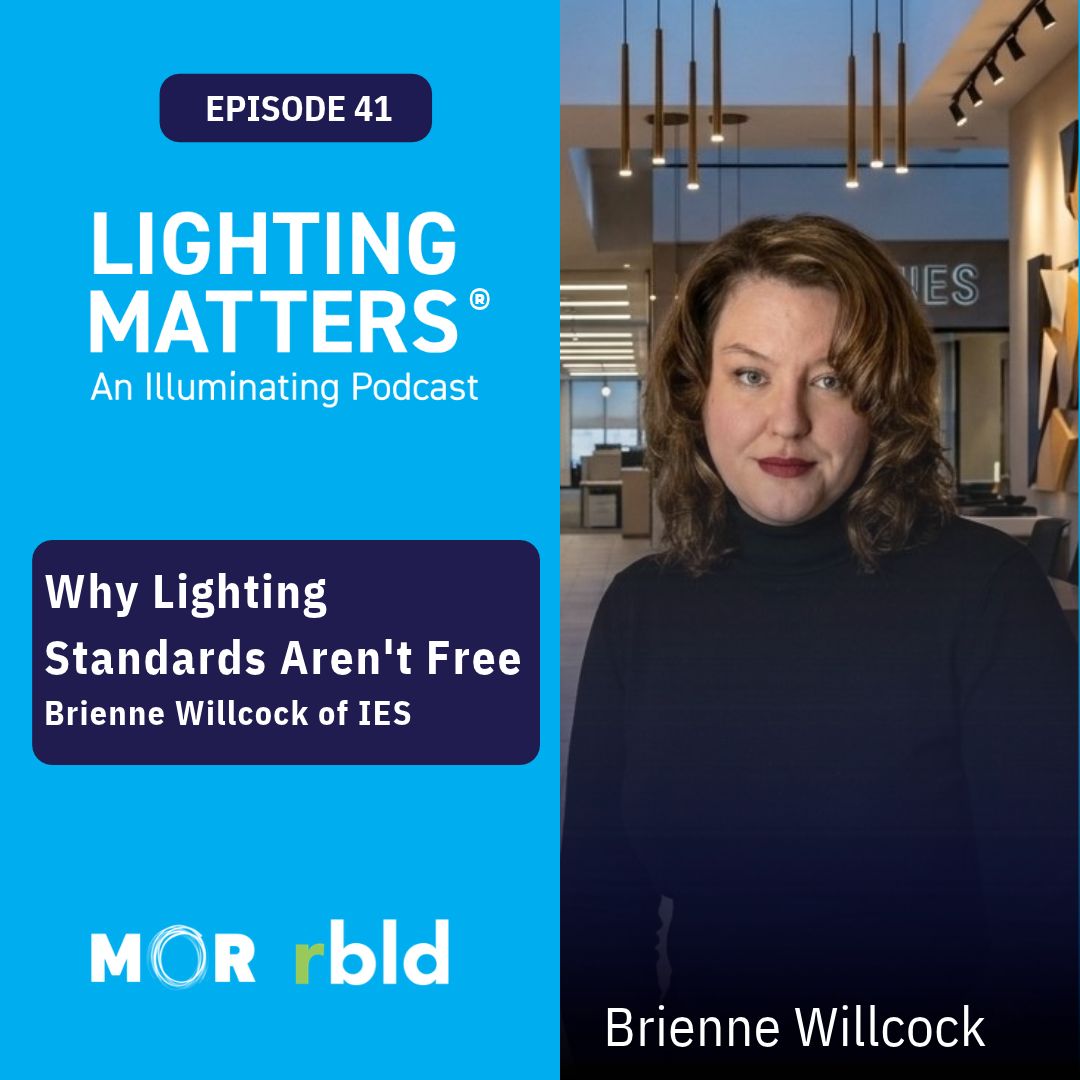
[00:01:13] Speaker B: Yeah, we've been trying to put this together for so long. I'm so excited. This is Avi Moore with more lights. We have Brianne here from the ies, and you've been. There's just so much, Brianne that you are so passionate about lighting, and what better place to talk about passion and light than on the Lighting Matters podcast? So welcome to the Lighting Matters podcast.
[00:01:38] Speaker C: Yes. Plus your name and the IES comes up on the show all the time, so you're definitely a rock star around here.
[00:01:46] Speaker A: Here I am.
[00:01:49] Speaker C: So can you tell us a little bit about who you are and your background and what inspired. Inspired you to go in the direction that you're going?
[00:01:58] Speaker A: So I started in lighting design.
So what do you guys do is obviously near and dear to me. I actually wanted to be in lighting kind of as an odd fixation with my one lighting class I took in college, and I didn't actually, like, I couldn't in that class. I couldn't let go of all of the details. I was so oddly obsessive in that class in a way that I, like, did not find myself being other places. And I already had a fine art degree in drawing, so I had learned to observe things first and then I learned lighting. So I had this kind of backwards way of. Not backwards, but a different way of thinking about light as part of the observe the way we observe things as opposed to something that you apply.
And so I was working as a graphic designer, actually, because that was the job I got out of college, the second bachelor's degree, and I ran into my lighting professor in a cafe and he said, are you still interested in lighting? And I said, yeah. He said, do you want to come to the office next week? I said, yeah. And it turns out I was his replacement. He hired me as his replacement, like that Friday. I was hired on the spot by Stephanie Graff and Robert White. STEPHANIE Graff FELLOW in the iald, longtime lighting designer, awesome advocate. He wrote why Hire a Lighting Designer? And some of the specification integrity stuff for iald. And he kind of walked around during my interview and picked up his guitar and like sat back down and looked at my portfolio. Like two or three pages of my portfolio and the rest is kind of history. So started lighting design. Spent a lot of time reading standards. I have told the story before, but not on a podcast. So yay that I was on a plane once and I was reading TM21 long time or long term projection of Lumen Maintenance. And the woman next to me was reading Cosmo. And I thought, man, I'm a different person than other people. And I was on this plane and I was reading it because I had gotten stuck in this feeling of like, I want to apply this standard. It was critically important to General Motors at the time. They were. I was working on their global specification and I really needed to know why there was a difference between like warranties and long time, you know, our long term projection and why we had this 6x rule and all sorts of things about the way that LED was supposed to operate in the field.
After that obsession, I actually opened that standard and call. I just googled people down the list of authors because I was brand new in lighting. And finally Eric Richman at PNNL picked up and he was like, oh. And that's how I got involved in lighting Facts, Avi. That's where I met you. And it's how I got involved in the Caliper program and some other things and then spent so much time on that stuff that I was like, maybe I should go to ies. When they were hiring for an education coordinator, I contacted them and said, I want to come there because I'm spending a lot of my time doing this. So I actually spent about a year in transition between the firm I was at and I became a partner at that firm. And it was really fun and it was a great experience and I'm glad I started out as a designer. Made me very empathetic. I think, to that realm in particular.
[00:05:03] Speaker C: I don't think I knew your graphic design start, but it explains a lot. You really, the moment I met you, you stood out. You thoughts. You weren't just, you know, following along.
[00:05:18] Speaker A: I still do, but.
[00:05:20] Speaker C: Yeah, that's what I love about you.
[00:05:22] Speaker A: Yeah, I actually. So I explained this at the annual conference for IES last year in a talk with Mike Grather and Kim Mercier. We give a talk on color, the three of us, and Mike did metrics of Metrology, and Kim talked a lot about the experience and vocabulary of light and how to borrow from different disciplines. And then I filled in some of the background and kind of specification side. But I was working at the time I got hired in lighting. I was working for an heirloom flower company that helped historic properties match the flowers that would have been grown in that zone at that time frame. So Colonial Williamsburg, Martha Stewart, you know, like Franklin Wright Properties. So our job was to figure out exactly what flowers would have been historically appropriate for the grounds at a given property. And then my job was actually color correction. So I would like to. I would have a flower on my desk, and I would have the flower up on my screen, and then we would print it. And I went through a lot of color correction, trying to give people the most amount of information they could get from a photograph of what their garden may look like. And so that's what I spent a lot of time doing, was comparing colors. And I would take a flower outside and I would bring it inside, and I would take it outside and bring it inside, and I would take my laptop outside and bring it back inside. So it was just to my point earlier, it was an exercise in observation, A lot of observation. Yeah, you were an expectation management, which prepped me for design.
[00:06:42] Speaker C: Oh, that's.
I was gonna say you were struggling with light there, you know, with all of the color matching. I sure was, whether you knew it or not.
[00:06:49] Speaker A: And I was really grateful for that job too, because the context, I just deeply appreciated the context. I never thought about plants in that way, and I didn't think about them as a tool for architecture and expression and that to particular vein. And so it was really good kind of history lesson for me, but also a way to think about the environments that we occupy more holistically and then the way that those observations matter. Like Frank Lloyd Wright properties had two specific flowers that they wanted, and it was critical that all of them matched and were intentional and all that kind of stuff. And so it was an interesting job. To have.
[00:07:25] Speaker B: So now with your current role at IES, it kind of seems like you wear about 500 different hats.
I always, when people tell me or talk to me about the ies, like they are doing 20 million things on 50 cents, just kind of curious, like, maybe at a high level, like, where are you in IES these days? Like, what are you kind of doing? And then let's start there, and then maybe that'll lead us to what IES is doing.
[00:07:57] Speaker A: When I first got to ies, I was education coordinator. And then I've sort of evolved. My role has evolved in part to respond to staffing changes and other things because when I got hired at highest, I think there were 28 of us, and now there are 14.
And we didn't terminate any of our main programs. And so there was a lot of redesign of who we were and how we were going to operate and, you know, to what extent we were going to serve the members with a lot less than we had previously. So now that I'm the Associate Executive director, which really I still focus on standards, education and industry engagement, that's my main focus. But when we started managing the Audio Engineering Society, we Colleen, very rightly and smartly, Colleen Harper, the CEO of is, put an associate Executive Director in place for AES and associate executive place in IES so that she had leadership in both areas. And then when we share resources, need to collaborate because the same staff run both organizations, we have an opportunity for some division of purpose and kind of focus, but also some leadership that she can rely on for certain things. So it has evolved quite a bit since I got here. My main focus is the standards team and education team. Education still seems to be kind of the forefront of most of what I focus on. And then, as you know, I dabble in advocacy when I can. Although IAS is 501, which means we don't lobby and can't. So there's some distinction there about reading regulatory updates and being aware of progress versus trying to weigh in on it. We have a balance to strike there. And then I work with a lot of our partnering organizations because Colleen and I make a good team in the sense that she's not from Lighting. So if we make inroads with a new organization, it's just smart to have both of us there from a lighting perspective, for sure.
[00:09:47] Speaker B: And you just touched on something that I think is really fascinating with the Audio Engineer Society. And then also we just talked about it on the podcast, the merging or the managing of the National Lighting Bureau and I think there's also the ncqlp, right. So like, can you talk a little bit more about what maybe less about the Audio Society? Because I think, and I mean you probably say it better but like it's a financial model ultimately to assist, but now to kind of bring in these other two lighting organizations, like where that thinking's going.
[00:10:23] Speaker A: And so I want to touch on the audio thing quickly only because I found myself explaining recently at leadership forum and I have explained to some for ies and I've explained to some folks for emerging professionals that we have so much empathy with light and sound because we both work with these mediums that are difficult to describe. We have common vocabulary about distribution and reflection and those types things. But we also, if you look at, you know, AES's mission statement, our mission statement, it's we both have knowledge as part of it and we both have a commitment to gathering a community. So I think what people get a little bit incorrect about AES so far is that it's not acoustics. So acoustics is the Acoustic Society of America, I believe it is. So the AES folks really are like lighting in the sense that they are about a device that distributes right in the built environment. And they are impacted by materials and finishes like we are. They're impacted by the volume of a space, both literally and kind of in the architectural volume sense. And so I'm interested to see how education might evolve to help each other, help understand each other. So we've written this prospectus for a potential webinar where we talk about the impact of architecture on these two disciplines because of the way, because of the nature of it being invisible until it strikes something. And so I think that there's some connections there worth exploring as we move through things because they still audio such a big part of enjoying an environment. So hopefully someday we'll read menus more easily and there restaurants will be a place that you can hear a conversation but you know, one can help.
So I'm grateful actually for that kind of juxtaposition. For now, that is a financial model for us. Certainly we get a management fee and we have some shared resources. But the cool thing about the shared resources part is that we, they have research papers like we do. They have peer reviewed, you know, the peer reviewed journal aspect of things. And so we already had this expertise on staff, right? We're not a typical like nonprofit management company. We have actual like we have research people who care about that, we have standards people who care about that. So it was actually A better fit than people might think for us. And then I think so NCQLP was a couple years ago. To me, that's very logical, right? They maintained their board, they maintained their identity and agency. But by connecting the two groups, at least in terms of a management perspective, you get an opportunity for a little bit more continuity, a broader reach Certainly, because IES's contact database is huge. We're a CEU provider. So I actually can't do much with the NCQLP side because we keep them separate from a CEU integrity standpoint.
But the way that that came together is interesting because it's still. Because lighting doesn't have that higher ed funnel in a lot of areas. NCQLP is almost, I don't want to say it's a replacement for that, but it's almost a supplemental. And the way I think about it is a supplemental pipeline into the industry. And so why wouldn't IES be kind of at that pipeline of folks who are, you know, three to five years in and want to be, want to develop their career in a certain way? And then NLB is really about reducing, don't want to say reducing competing things because I don't consider it that way. But I do think that when we talk about sponsorship, we talk about education, we talk about things that. I think it's been very broadly recognized that when groups spend the same money and resources to do the same outcome, that there are practitioners and other folks in our world who want to see that be reduced, they want to see redundancy reduced, they want to see resources being used better or more wisely.
So NLB is a great example of that. It's not about revenue for us. It's just a really good opportunity for us to do better education. That's public facing. That's NLB's strong suit. Tom Butter will be back in the fray, which is great. We worked together really well when he was on staff and so I'm excited for that education arm to kind of continue. So in a lot of ways these are very intentional decisions on our part. But. And a lot of discussion goes into is this mission supportive or is it mission distraction and how do you make a decision from that place? Right. And obviously the board of directors decides all these things. This isn't up to, like Colleen and I, for example. But still, I'm, I'm glad for the kind of little. The. I was going to call it a family, but that's not quite right. But I'm, I'm glad for the visibility that we have to the three organizations. And it was our first year with AES. And so next year I suspect that we will have learned things from each other.
[00:14:54] Speaker C: I think first, I just want to say, and we've probably said it on the podcast, that intentionality that you mentioned, everything being very intentional. We've noticed and it's impressive. And I really just want to comment and tell you how much we appreciate that. And it's. I know it's been something that we've had to do as an organization because of funds. You know, every move move has had to be intentional. But well done. That's all I wanted to say about that. But we talk a lot about other organizations that lighting has to get in front of that need to understand us. And it sounds like maybe the audio engineers also need architects or interior designers or some other practitioners to understand them.
And is IES doing what is. Yeah, what's going on on that front?
[00:15:45] Speaker A: We've made. And AVI knows because I've given him an earful a few times about like all the inroads that we've made with other organizations that I'm super excited about. Like we have the National Electrical Contractors association, they're attending our commissioning symposium on October 8th. And we are working with ALA, American Lighting association and NLB and IES are all doing a residential symposium in December. And so ALA is very different than IES from an outward facing education, but also from a residential knowledge. And so we're going to all get together and say how could we all achieve our goals through this process? And so some of it's been that. Some of it for me on the advocacy side and kind of the allied organizations I would call them is about. I just spent some time and every time I visit a section I say this too, but I just spent some time at Leadership Forum explaining that people should go to other people's meetings. Like go to an ASLA meeting, go to an AIA meeting. If you want them to come to you, go to them.
And you have to have empathy and understanding of them. But I also think we just launched our Allied Organization program. So if someone pays dues to not a lighting organization, but something adjacent to us, ASID, AIA, they actually can join IES at a much.
I think it's actually less than 50% or it might be 50%, double check that. But dues because we recognize that as a discipline that might rely on lighting or appreciate it, maybe they don't need to spend all this time there. And the allied organization is supposed to help us, you know, Break down some of those. Some of those barriers. So we are very, very cognizant that lighting people want to be in front of others. But I also think that we want to be the host of a party, and we are ignoring that. They can host. Like, you can just be a good guest. Like, go be a good guest at an architecture event. Go be a good guest interior design event. Show them the lighting matters by asking them, okay, well, interior designer, architect, like, what finishes are you willing to, like, not have lit? Well, like, in other words, I think if you flip it on to what they care about and have them start to prioritize things, the value of lighting starts to become about what they want to accomplish, rather than what the lighting designer wants to accomplish. Right. I know I'm kind of, like, off in a world here, but I think that there's a lot to be said for, like, small advocacy or soft advocacy of, like, this is about the built environment. We're all after the same thing, hopefully. And so I do think that there's a way to pivot how we talk to other organizations and how we relate to them that is more about being collaborative instead of this very real want. And I think it's justified to a certain extent for lighting designers to prove their worth or their. Or to get on every project or. And I get that passion. I totally do. But somebody's doing the lighting, right? We know this, and you guys have talked about on the podcast, somebody's doing it. So I actually reflect back on my own design timeframe and wish I would have said more often, what things are you willing to not have lit? Well, what finishes have you chosen in your studio? So carefully curated, Are you willing to give up and try some of that? And I loved my favorite clients were actually my favorite client ever. I probably shouldn't maybe admit that, but it was a landscape architect. She was so awesome because she cared about, you know, the initial plantings and things like that all the way through maturation. And so if a mature tree canopy was not what we were originally lighting, she and I would sit down and go through everything, how everything interrelated, how to have less disturbance in planting beds because of conduit, how to be, you know, I'm in Michigan, so the four seasons are very real. And how to be cognizant of that for the lighting. And a lot of it is because I think I cared about the plants too, you know, not just the lighting. So I think some of that. And I guess maybe this is a mix of kind of the ies world and my personal kind of philosophy on the lighting industry. But I very much believe that we're getting very close to being good hosts of a party. But I also wish we were better guests and got outside of ourselves a little bit better.
[00:19:41] Speaker C: No, that's awesome. I mean, I just like when you said that, it took me back. I started, started out in architecture school. I love architecture, you know, I really appreciate it. And I. I've noticed that I have to remind myself to stop and look at it because I'm so focused on the lighting all the time now. So.
[00:20:00] Speaker A: Yeah, well, we want to create moments of awe, but I'm not always sure we're open to them unless we've created them. Like, you know, when you light something really well, you're like, oh, I feel this sense of awe. But if you go into an architecture space and you allow it yourself to just be reactionary to it and not feel like you're a productive part of it, I think it can do a lot of good for some humility, first of all, that other people can also light well.
And also I think it reminds us a little bit without the liability brain, right. Like when I was a designer, there's just liability and pricing and value engineering and all the things that you're, you know, are a risk taking awe away. And you can experience awe and describe it, but when you know that there's a risk to it, I think that you start from a scarcity mindset. And so sometimes there can be this kind of limiting way of thinking. And I'm really fortunate to have been taught by Robert Wayne, Stefan Graff, both of whom are shoot for the moon kind of guys, and then they pull it back as opposed to, you know, being more maybe pragmatic and kind of getting bogged down by that. So the way I learned to practice, it was just different.
[00:21:02] Speaker B: What's amazing to me is just what you're talking about is very much what I'm perceiving in the, in the direction that IES is taking, right? This idea of light for everybody, right. I mean, just had a symposium, right? Like light for life, right? The symposiums, the. Everything's kind of going in that direction. And I guess where. The question that I wanted to ask is, where do you see this kind of leading? And again, personally, if you have to separate from ies, but like, there's been a lot of conversing and we've talked about it here on the podcast, that there's almost too many organizations, there's almost too much going on, and you Kind of said it, and I want to put a little bit more of a pin on it. We also brought it up during the neocon talks with some of our manufacturers is that our manufacturers are getting asked to fund too much.
[00:22:00] Speaker A: Yeah, yeah.
[00:22:01] Speaker B: Whereas like, we, we need. And, and I think it's worth saying again, there isn't a single lighting manufacturer that I'm aware of that's anywhere as big as any of the steel manufacturers, glass manufacturers, or even the furniture manufacturers in the built environment. Right.
[00:22:19] Speaker A: Yeah.
[00:22:20] Speaker B: We, as a lighting industry, our biggest manufacturers publicly traded, are still smaller than some of those companies. Right. So I guess again, coming back to the question is where do you see this going in, kind of like merging and telling this story?
[00:22:37] Speaker A: Yeah.
[00:22:38] Speaker B: What's that? Well, not necessarily what ies, like what you see as, as a, as a luminary in this industry.
[00:22:47] Speaker A: You know, I'm going to give you like a quick personal thing and then I'll come back to the IES side. We talked a little bit about observing lighting. Right. And we talked and, and I spent a lot of time thinking about lighting quality and the things that have impacted my life. And one of the big time things toward my life is taking care of my mom. And I'll spare you to a certain extent what that entails, but she has been in a lot of health institutions my whole life. And so I was doing a talk a few years ago and asked her how she felt because she's just spent, I'm sure, a year of her life in an inpatient environment of some kind. And when she was describing everything she felt about light, her relationship to lighting, being surveilled, you know, kind of that feeling of this kind of uniform, constant thing in her face and that kind of stuff. But then when she was at home, my mom's an artist, my dad's an artist too. So I was learning these very strained relationships to what, like, can do what it should do and try to pay a lot of attention to that relationship. Right. Because. And then my parents were also taking us to art museums when I was a kid. And I would go from like the Chicago Institute of Art or Diagnosis, sorry, Detroit Institute of Art, we all call it DIA here. And then I would go to the hospital, you know, and I would, I remember even thinking a lot about environments because my dad used to be an architectural designer in retirement. He's a sculptor. But part of what I think about when it comes to IES is and, and I'm bringing it back to the other organizations to say a sense of belonging is critically important for someone who like. The reason I share some of the personal experience is that for having been in a number of environments, which I appreciate for different reasons. Right. You appreciate an art institute for a different reason than you appreciate a hospital and what it's supposed to accomplish and how. What I think is that when people have a sense of. That they need a sense of belonging. Right. That they're not finding lighting people that they want to relate to fast enough to accomplish what they want either for their own kind of socioeconomic things or affinity groups, you know, we call them affinity groups or personal identity. I totally understand that. I have a personal identity kind of relationship to light too.
What I think though, and I'm biased again, I mean, I'm biased for ies. I'm sure that's evident. I like that I work for an organization that helps accomplishing those lighting goals for the built environment. We have over 40 RPs. I think we're at 43 recommended practices.
And the goal there is for us to invest time and energy in getting people up to a common ground or a common understanding of lighting quality that we all can hold each other accountable to, that we can inform other disciplines about. And I like that we do that. That requires a lot of money. It just does. The standard, the value proposition of standards is very difficult. It's difficult at every standards organization. We do a lot of benchmarking with tons of different standards developers, not just in the lighting industry, but we benchmark ourselves, our pricing per page, our pricing for public review, all the things we do to support standards. We benchmark it against about 50 organizations to make sure that we are always in best practice with that. I do think that a lot of the sponsorships that occur and everything else comes down to what a manufacturer believes is their role in the industry. So if you believe that your role is to facilitate networking, by all means, please go do that. If you believe that your role is to provide lighting quality in a way that's like measurable and consistent, then you should support ies. If there's other things that feel more like there's inclusivity things and so you want to do something that's DEIR related or DEIR in that sense space. Our particular group at IES is called deir, then support that. I think a lot of organizations need to find their own identity. What I would the feedback. If I could say one thing to manufacturers, what I wish is that they knew themselves in a better way to say. When they say no, they say why?
So I think it would help our IS sections a lot. I think it would help different educational events if manufacturers had a set of goals or things they really want to accomplish with their sponsorship dollars and were informative about that. Because if that was the case, then there might be less asks and there might be more intentionality around finding a better fit. So often if I'm thinking about a sponsorship for like an educational thing, I will make a list of maybe 20 manufacturers I know that care about that thing. And then I might narrow it down to the 10 who are really good at that thing. And then I might narrow it down to another, you know, the five that I should start with.
I think when you're competing for dollars, whoever's asking for that is important, but whoever's giving it is just as important. There's a relationship there. This is not. You don't just take a sponsorship and then run.
It should be a conversation that you're having or a dialogue. So there's a lot of organizations competing for dollars. Don't get me wrong. I wrote a couple articles in ldna. You're well aware of some of the advocacy little things that have. Not little things but advocacy kind of threads we've been pulling out in the last year and a half.
And I think we're at almost 30 lighting organizations based in North America. Their primary influence might be outside of that. Like ILD is a great example. Right. But their base is North America, where their office is. And 30 is a lot. It's a lot. It's a lot of people who want education, it's a lot of people who want to give it. And sometimes I think this is that hosting a party analogy where I'm like, do you just want to host one that you have control over or do you really want to accomplish something specific? Because when I hear the IS isn't doing a good enough job in advocacy, which I hear, you know, probably once a week from somebody, I often find myself asking a number of follow up questions, often met with crickets and not getting responses. But I'm open to the humility that IAS has to have to say we have not always been the best umbrella, we have not always been the most open door. I think for a long time we really wanted to be a lot like other standards developers where you kind of hover above the discipline because you know, you do have an immense responsibility to keep that discipline honest, consistent, specifying, whatever you specify, regardless of your discipline, with integrity. And there are organizations who have to stay at that level. They have to hold themselves to A higher standard. I think that got misread. But I also think we didn't do a good enough job of how of breaking down some of those things. Like, I. We've talked about this before. Like, I don't believe in dumbing it down. I don't believe in that phrase at all. People either know it or they don't. And you can offer to meet them where they are or you can expect them to come to you, but either way, education is supposed to bridge that gap.
So when we have those gaps and people describe them to me, I'm aware that is has responsibility here in why the industry is so fragmented, because I think some of those groups have come up because they didn't find a home here. But I also wish we focused a little bit more on what we could accomplish kind of as a collective.
[00:29:31] Speaker B: Lisa and I, the previous podcast that we had, we were talking about how to actually, you know, what can we keep doing to elevate the professional lighting design. It's something that, you know, we're now two years into this podcast. The reason for creating the podcast, where does this conversation live? Well, there isn't a place for that. And we wouldn't ask at the time two years ago, ies to go fund this expense. I mean, there's an expense associated with it.
[00:30:02] Speaker C: Right.
[00:30:03] Speaker B: But beyond that, there is this conversation that needs to be had. And what we are wrestling with is where what I love about what you're saying is, yeah, okay, so then we need to fix that, right? Like, don't take the way it's always been done. I actually have this personally, a very difficult time with thinking that the past will change.
That's a mental problem I have. The past is not the future right now. Sometimes you have to get the proof, right? This contractor screwed you over last time. Is he going to do it again? Well, maybe there's a different project manager, so you'll be okay. Right. It's the same thing here, right? Like, what is the future going to be? Well, we can look to the past and say this isn't going so well. And we are 30 organizations again asking for small, small pools of money to elevate a pretty significant thing. I mean, all of us in the lighting world believe that we're a significant business.
[00:31:10] Speaker C: We think we're so important.
[00:31:13] Speaker A: We really do well. So let me give you the high level, I guess IES things. One is we're very comfortable now with customers versus members. Right? Lighting is still something to. Lighting information is still something to consume. So, I mean, you Know, the education can be a one and done and I still consider that small advocacy and then it can be a lifelong pursuit. And I think that both of those are important and IES has a job to do both. And so we just hit 10,000 learners on our E learning portal last week. And I started that when I got here with the team, of course, but it's been like my baby since I got here. And they're 54% of those people, right, are members of IES. That's in. So you would think actually it might be a little bit less than that. But so that means that they either work at a sustaining membership or sustaining member, I should clarify, work as sustaining member or they're an individual member. But the good thing about that, what that tells me is that we're reaching, you know, 50% of the people on that portal are not members. So they found us because they really wanted to. And non sub members don't find us for that reason. But members hold each other accountable a little different. Have you learned the latest thing? Can you specify TM30? Do you understand it? That's not typically, you know, wider spread outside of us. So I do think that the backbone of a lot of this work could have been to your point about looking at the past, I'll say briefly, IAS about six years in the red, right. 20, 25, we end in the black. Advocacy happens when you're, when you're concerned. Right. And I think with the influx of life or money at ILD and ies, we weren't concerned. We were sustained. We had a huge team of staff and so we could spend time on the concerning things about advocacy that are resource heavy. But also we had time on our side because when you have money, you have time. And I think that particular kind of implosion right into with COVID became a time where our concerns got kind of and fragmented and there was less cohesion at ies, there was less cohesion in other organizations where people were kind of coming together under one kind of thing they really wanted to accomplish. And our mission has to be to benefit the public. We have to gather people together with lighting knowledge. That knowledge has to be translated to benefit the public. That has to happen.
So advocacy can look pretty different for us from a small wins all the way through the big ones. But when there's more noise, if you Google like lighting organization and 25 of them come up and you don't know who to trust, then it is difficult to position yourself as something that, especially with, you know, 108, 109 standards I think we're at now.
We have, and we've been around since 1906. You know, you hope that between those two things, that that gives us some kind of stronghold in trying to help the industry move forward, but not sure we've always earned it. I think we're getting a lot better at it. I also think that we have started to really value small advocacy. Right. And I've said this before, and I'm sure I'll say it again, that sometimes if somebody emails me and says my neighbor's light is too bright and I'm really over it, and they happen to find us somehow, right? So they've gone through the process of googling through the whatever or whatever AI thing they're using. If they found us then, and our mission is to benefit the public, then the next best thing we can do is. Well, we do two things. One is we connect them with the local section closest to them geographically, so that they might find an expert nearby, and we connect them with the relevant technical committee. So if there are questions about outdoor lighting, we send it to the Outdoor Nighttime Environment Committee, typically the chair, and let them work through it. I know that advocacy sometimes, especially in this context, can be more lighting designers on more projects. I'm on board. But I also think advocacy can be in these other pockets of things where some of that comes back around to say, you know what, lighting people are really helpful and letting people could be ies, it could be a manufacturer, it could be anybody. But if lighting people are generous, which is something I think people conflate that with, like, our standards should be free. No, but we should be very generous. When someone comes to us and says, I don't understand and I want to, and this is impacting my life, if we respond appropriately, I really think that builds more trust in an industry that is constantly begging for it, you know, And I think, I guess constantly back and forth is a little bit harsh. It's not quite what I mean, but it's very real that we. And coming from a lighting design perspective is very real. We've had to advocate. When I was a lighting designer, I felt so strange about having to advocate to stay on a project or to get through a construction administration or to be part of the whole time. What a strange thing to have to defend that. You just do your job well. It's such a strange conversation to have to be like, I'd really like to do my job well, if that's okay with you, like, can I just stay on through Christian administration.
So I don't mean to take away from that, but I do think, hope that the IS is continuing to position itself that at least we've accomplished our mission, even if there's other things we haven't done. Like maybe we haven't been the best group for people to come to that needed some more inclusivity or belonging.
[00:36:12] Speaker C: I'm hearing a thread starting with when you, you talked about, you know, your TED Talk on awe, which I totally want to hear and I'll work on that. Yeah, and manufacturers needing to know who they are and the splintering of all these organizations and yes, being really focused on its mission. That to me is all a little bit of the same thing. And it's this slowing down and allowing yourself to think about.
I'm going to quote from a book I read recently, but think about the complex and not just the complicated. And we get so busy and heads down in the day to day and I got to stay on this project. I gotta, you know, I need to stay on through CA or I need to define lighting design to this client.
And it takes a little more energy and a different kind of thinking to focus on that complex. Like who am I? Who are we as an industry?
But to what I said earlier, it's showing that IES has that clarity right now and it's a beautiful thing. And if we all take the time to slow down and understand who we are and what we care passionately about and then focus on that, we're all just going to be more efficient, more productive, happier. I don't know. I'm. I'm really fascinated by what I'm hearing you say.
[00:37:34] Speaker A: I think too though, there's this element to the point about like focusing on ourselves. Right. When you're a lighting designer. What can I learn from an IES meeting? Should I go to my local section meeting? Is it a topic I care about? I could join a committee. Do I want to join a committee? Do I want to put that much time in? It's all, how do I relate to this industry?
And a lot of people measure the success of IES with how. What have you done for me lately? Right. It's a common thing. It's not about you. It's about the industry with which you are a part of. It's like when you're stuck in traffic and you're frustrated with traffic, but you are traffic and you're like, but there's this lack of acknowledgement of your contribution to the noise or to the congestion. So I often say to People. When people have said something like, well, I just don't think IES is effective as it needs to be, and that kind of thing, I'm like, for you or for an industry? And have you thought about what the industry. Where the industry gaps are, even if they're not a gap for you? So when we do education that people are like, this is dumbed down, this is too simple, then it's not for you. It was designed for someone else in the industry that you deeply want, respected, supported, advocated for, funded, I mean, you name it, right? We want this industry held up because that's what makes it resilient beyond our own self, individual selves. However, the idea of individuals going through podcasts and articles and all these ways of saying, this is what we need and what we want and why we respect each other, I do think a lot of that pops up when you don't have as much trust in the large organizations that should have been doing it all along. And maybe they didn't do it the way you wanted it. Maybe they were doing other things and got. And you feel like they got distracted. Maybe that's true, maybe it's not. But I do think it's very realistic to say, have they upheld an industry? You know, have they, like, we're an answer. We're an American national standards institute. We still are. It doesn't matter if we're ending in the red or in the black.
And it doesn't matter if more language centers are on our projects or not. I mean, it matters in the grand scheme of things. But I'm saying for us as a standards developer, there are facts about us that we have to maintain. And so I always hope that when people have maybe gotten a little bit burned out by ies, maybe they've given too much and got too little in their perception or realistically.
Or maybe an email, the headquarters went through some roundabout way of hitting several staff and they didn't get the responses they wanted, things like that. Because I hope that there's some grace left in the question of, like, are they holding up the industry that I'm part of? And if they are, then maybe there's, you know, a different way through it to abhi's point about, you know, focusing on the future. But I don't have a great recommendation for how fragmented we've become. But I do know that the more we talk to people that are similar to us, the worse this gets. So I get concerned about the fragmentation from that point of view when you start to get into these pockets of people who deeply want to belong to something. But they're not creating belonging for other people, they're creating belonging for the people they are. And that's what is was criticized for doing. So actually we're seeing the solution be this exact same problem that it was supposed to, you know, resolve. And it's not actually a solution then.
So I don't know. I don't know if the pendulum will come back the other way. I don't know if it should.
I very much, you know, take a lot of direction and guidance from our advisory panels and the board of directors and stuff like that. So I don't want to seem like I have all the answers or that I should. But I certainly do think we have some work to do on the identity front. And when it comes to manufacturers especially, there are some, you know, family run and started or. And manufacturers who absolutely know who they are. They know what they value, they know what they want to support, like education. Right. There's a couple, like companies who are just die hard about education. They make it known, they invest in it. And I'm like, how awesome is that for your brand? Like, that's great. Please continue to invest in education. If that means ies, great. If it means somewhere else, great.
[00:41:13] Speaker B: I'm having dinner with one of those manufacturers today. They're amazing. I mean, that's like, you know, very much involved in ies. They've sponsored this podcast, they have been involved in Illuminate, which I think is something that love to spend a moment on too. But yeah, I mean, it's amazing to me what clarity about the organization has ultimately done to the organization.
And you know, I'm sitting here not wanting to speak about the organization that I pay a lot of money for that is doing a lot of what you're saying, right? Like, I look at what I pay my staff to be involved in IES and why, it's because I see the benefit for everybody, right? Like the standards, the, the moving controls, the. I mean, even some of the standards that I'm not involved in. But I read, like you said, like reading on an airplane and being like, wow, these are some really smart people that have learned a lot of cool things and I want to know more about that. Right.
[00:42:22] Speaker A: Well, and every time you pull an IES file, like, I hope somewhere in your brain it triggers like a. Oh yeah, there was a group who standardized this for me so that I could run calculations which, you know, are. Is entirely the built environment and then go out and meter it.
And we don't hold the SI unit, right? That's cie. But I still think the IES file is such an interesting backbone, and yet it's underestimated, undervalued, and all sorts of other things. And it's interesting because I've gone to global shows and people are like, wait, so, like, you're like, the file? And I'm like, no, no, the file's an organization. It's not like, PDF is Adobe. Right. I remember exactly where I was at a show and I stood there sort of dumbfounded because I was in a manufacturer's booth and they were like. And it was global, right? So different. But I.
They were so taken aback by the fact that IAS was an organization because if you look at a major. There's a major manufacturer who mentions I S files eight times on a single page where you can download the catalog and everything else doesn't describe who IES is, what they are, doesn't link to us.
So they make your job possible. By way of this manufacturer's website, you download all your I S files without ever having to say, there's an organization that did this. So it's interesting because I always am like, well, PowerPoint's Microsoft, right? And we missed the boat in. Is is like we named the. I mean, the file is named a file, and yet we still somehow missed some type of boat there. Like, where.
I wish if I could go back and I can't, and I wasn't actually on staff at the time that the IES file was determined and defined and all of that.
I wish I could go back and say, okay, manufacturers, maybe there's a small licensing fee you pay to IES so that people can actually utilize your product in advance. And you teach people why predicting light matters in the first place. I just started a page on the website, that's why predicting light matters. And it describes how calculations work, how AI files work, why they're important, what to look out for.
[00:44:19] Speaker B: Even having, like, at the top of an IES file, if you open in a text file, it says, you know, IES LM60 or TM60, whatever it is. Right. Like, but the next.
But it should say the very next line.
A byproduct of the Illuminating Engineering Society. Or, you know, like, whatever the.
But like, you know, immediately after it. Like, this comes from this organization.
[00:44:49] Speaker A: Yeah, organization.
[00:44:50] Speaker C: Here's the website.
[00:44:52] Speaker A: Yeah, yeah.
Effects of downloading this might include, you know, I think that there's.
[00:44:58] Speaker C: Because they're knowing what to expect with your lighting. Yeah.
[00:45:02] Speaker A: And it's funny because when you go back to the idea of a manufacturer's identity, right, all of their identity is about selling product in the end, right? And selling product is possible because of the cut sheets that have standards completely embedded in them, even though they don't credit ies. And then, then there's IES files where we're completely embedded. And I think that consistency earlier is what I was talking about with like, who the IES needs to be. That consistency wouldn't exist if we didn't uphold that type of robustness. And so it's so fascinating to me to like look at spec sheets from that. And I love when a spec sheet says, like, Is LM79 compliant? I'm like, that's not real, that doesn't exist. Or when a lifetime production is associated with like testing in accordance with such and such. And it's always like IS with our little alphanumeric thing, you know, TM21 or whatever. But there's no identity there for us. There's no IS logo on the spec sheets, there's no IES logo or even link on major manufacturers website websites. And I often think to myself, how many millions of dollars of product have you sold because somebody could download an IS file, believed it was Credible, put the IS file into AGI32 or Lysanza or wherever else, ran a calc and said, okay, here we go. Because the initial information sharing and the formatting of that, now of course manufacturer paid for the test, right? And they have the lab, either third party or internal, that kind of stuff. You don't mean to downplay that.
[00:46:24] Speaker B: But the test the lab had to do is an I as well.
[00:46:29] Speaker A: And those standards are like $60 or $90 or something for a lab to read and to calibrate to. And so when people think, oh, IS standards should be free. And I'm like, but how many IS files have you ever downloaded that standards cost money? They just do. We have copyright things, we have anti fees, we have staff, we have a typesetter, we have an editor. I mean standards are a, our standards touch at least six people before they can just on staff, on the staff side or staff consulting side before they can even get out to the public, right? So this, those six people deserve to be paid to make that industry backbone happen. And like an IS file, for example, this is one example, but it's a big one, right? Because we all relate to it ultimately,
[00:47:12] Speaker B: what you're trying to do and like the shift the way that I would explain it to somebody and maybe this is Just my simplicity of it is trying to elevate the brand of the IES and its members because ultimately its members have access to these standards. Many of them are very much involved in writing, maintaining, suggesting, modifications, whatever it may be.
[00:47:36] Speaker A: Yep.
[00:47:37] Speaker B: And then the last piece of it is where I think Illuminate has a super powerful position, I think, going forward and sounds like that conversation has started, is to take what we did last year with the vignettes, and I think you came up with this idea. And this is what I've been kind of pushing is then tie those back to the recommended practices and the standards that I asked.
[00:48:03] Speaker A: You can replicate it at home. It's like, try this at home, you know, or as seen on tv, like just some connection to implementing it, you know.
[00:48:10] Speaker B: Yeah. Like the one that we did with Lighting Services Inc. That we're talking about color and color space, like that could easily tie directly to that standard. And what I like about it and what brings it back to lighting designers, who I would argue almost all are members of IES because we need those standards and recommended practices to do our work. But ultimately it brings somebody to that to say, wow, this requires. I'm glad I understand the technology and the reasoning behind these decisions.
I need somebody to help me make these decisions.
[00:48:49] Speaker A: Yeah.
[00:48:50] Speaker B: And unfortunately, we don't have an organization right now to help people take us from that technical to that creative professional that can help them with it. Like I said, many are members. And I really like what you were saying too, Brianne. There's parking lots and there are.
There are spaces that just need the standards and light applied appropriately. And there are members of our society. I mean, I'm a member. There are members of our society that are great for that. But there are also the standards. And the standards are actually, I like the recommended practices that give you ranges of choices. And it takes a professional, I would argue a lighting designer to explain why this part of the range makes sense, or this part of the range, or given that group of people said range A to B. But you know what? C is going to work just great for what you're doing. And this is why, yes, this is what that group of people said, but this is why I think C versus
[00:49:55] Speaker A: A and B, I have said almost probably verbatim, similar to what you just said at some point, you know, in my career. But I. I do think that to the point earlier about other disciplines, one of the best things lighting designer can do is teach a client or whomever why what they're doing matters and what lighting can do to support it with a back, like a backer of this. We have, you know, 800 people that write lighting standards. There's a lot of benefit in saying we're following a recommended practice. We may have deviated from it a little bit based on our professional expertise or knowledge, which is always going to happen. Lighting quality is supposed to be accessible in a common, approachable way. So some of our standards are going to take a median value. Right. And not consider the people who are truly your experts and should and can deviate from it. I mean, I have a fine art background, right. So it's kind of like you learn all the principles and elements of design and then you're allowed to break them. So if you're in the place of being able to break them, I think that going to somebody with some confidence to say, I have read this recommended practice. I believe in it, and so do these 30 authors. But also, this is what you know and care about as it relates to lighting. And I'm here to be the bridge here to be the bridge between what a group of experts has said and what you want to accomplish, because that's what a language center really does, is a lot of that connection point. And I think if we taught people to be better at connecting the discipline to the recommendation, and even when you deviate from it, that's almost more important than that individual's expertise on their own.
There's a lot to be said about trusting someone to be an advocate. You know, I mentioned my mom earlier, and I. I'm going to bring that back, which is funny, because I've actually never. Don't ever talk about her professionally. But I've been a patient advocate, a durable power of attorney for 20 years for her. She needs me to talk to a doctor and to talk to whoever and listen to everything that's going on on the technical side, translate that information in a way that she feels like she can trust. And for the last 20 years, I've been doing that. So the hope is that she can sleep at night knowing that somebody who cares just as much about the outcome for her as she does is listening and talking. Right. There's that. Both. Both. And so I think if lighting designers could listen a lot more to other disciplines, like a lot more. I mean, really listen and then translate what they know on the IAS side or whoever. Getting your education information from doesn't have to be ias, that might help.
And I realize it's like maybe a strange kind of philosophical trip we just went on, but I will say that if you look at patient advocacy, which is like, what I have a ton of experience in, and you think about the grace that you have to give to both sides of an argument or both inputs, the technical input, and then like an input from the patient, and then you look at the structure of advocacy and how advocacy is actually effective for not the advocate. It's not about the advocate, it's about the patient getting what they need from the doctor. It's not about.
So it entirely removes your own ego. It has to.
So you remove yourself from being the reason something is done, but you.
Because the reason is to get the patient from point A to point B. Right. But if you remove yourself from being the reason, but you're the biggest part of why the reason can be accomplished. And I don't have quite the right framing vocabulary here, but I think we would get a lot further and people would have a lot more empathy for our. For lighting people than we do right now. So is that your pitch?
Oh, maybe. Like, why.
Maybe we shouldn't have taken the patient advocate route. But it was like, it was quick on my. In my brain. Because I do think that reducing complexity for the person you're trying to accomplish something for is a gift. It's very generous. It's a generous spirit thing to say. I know all this technical information.
I'm not going to prove to you that I know it, but I am going to help you do what you want to do, because I have this expertise. And I've heard lighting designers say verbatim, if you just outsmart people in the room and you position yourself as the person who knows the most about lighting, that's how you gain, like, the trust. That's how you gain the momentum. And I'm like, nope, that's how you gain. Some people who think that you aren't listening and potentially you've alienated people who don't feel great about the fact they don't know. Like, we don't consider that an architecture and tour designer might not feel great that they actually don't know what you're saying about cctv. We're just like, well, you should care because I care. Well, that's not realistic. The reality is that they might actually not feel great about their education that they got. They might not feel great about past projects. That's another thing. Like, we, you know, we go in heavy with, like, what not to do. And I'm like, so we've shamed an entire industry to say, like, hey, your past projects weren't. Weren't what they should have been. I think that we make some missteps just in like, general human kind of relating.
[00:54:41] Speaker B: This idea of patient advocacy is really striking me as something I think, Lisa, I've been searching for, for a long time.
And it's what I love about this idea. And I'm going to do way more research. I'm going to go into my chat box this evening and dive into it,
[00:55:03] Speaker A: look up patient advocate.
[00:55:04] Speaker B: You'll learn a lot because there. It's exactly. It's an existing scenario, it's an existing application, it's existing language and everything associated, and it's something we can apply. And where my brain's going too is it's what an architect is doing. It's what AIA talks about when they're talking about their members.
It's what asid, iida, ASLA are talking about when they're talking about their members. Right now, I guess it's in a different place, right? Because we're writing those standards, we're writing those recommended practices. Right. I don't think it's the place for ies to say, you know, you should hire our members because they know how to apply. Right. That's not, that's not the position job
[00:55:56] Speaker A: is to educate the members so that they can hire. It's not about we. I don't think we need to be in the middle of it. And I could, if I could take the analogy a little further in the patient advocate, please. When you have patient advocacy forms for a number of different health systems, they always have all the things that you want or don't want. Right. In advocacy. And what's interesting is it's not unlike an OPR where you're like, okay, this is the structure, this is what the person has said to me that they actually want. And so a true professional combines what they know to be true like, like the back of their hand about, like lighting, for example, and matches those two things together.
That's the thing to do in not being out to prove how much we know.
And honestly, DIS is supposed to be kind of that helpful steward of like, when you're in that position and you have the thing that the person who needs the advocacy says to you that they want, we have your back on all the rest of it, the where to go, how to, how to do it, that kind of stuff. To your point, I don't think we're the right people to say you have to hire this type of lighting person. I also think that that puts people in boxes that contributes More to the fragmentation than less.
So there could very well be an extremely capable electrical engineer, for example, who does a lot of lighting design and has just never labeled themselves as that.
And I want a door open for them.
So that's where IES needs to stay. I think personally needs to stay kind of above board in terms of valuing one profession over the other or one approach to the profession than the other because it takes all of them to get a project off the ground.
[00:57:33] Speaker B: I agree even more than I ever have in my thinking about our problem.
I think the problem in our industry comes to the.
There isn't a. There isn't an organization that's taking on this. This client advocacy problem in our industry.
[00:57:53] Speaker A: And it may. I don't know that it will come from an organization. It may have to come from the members because they've been educated by the organization. And I don't know what that line looks like, but I can appreciate that the advocacy for the nuances around the profession of true lighting design need to be advocated for. And I think you can advocate for nuance about someone's professional credibility and capability without putting anybody else down.
[00:58:21] Speaker B: I think so too.
[00:58:21] Speaker A: Without making yourself better, without making somebody else less than. I don't think that helps the industry because the other thing that that does is it also positions other disciplines, like an electrical engineer, for example, in kind of a strange spot for the next project for that client. So if they're doing the lighting and they don't know as much as lighting designer, but they could afford a lighting center on one project and not on the other, you've just put that electrical engineer in a place of being less than. And I don't think that's fair. I do. What I think is fair is utilizing things that are consistent, that are consensus driven. Like in a recommended practice that could equally be applied by electrical engineer and a lighting designer. Now, is a lighting designer going to do a lot of nuanced work to make sure that that's done exceptionally well? Absolutely.
But that doesn't take away the fact that the recommended practice still stands alone as a lighting quality goal that other people can accomplish.
[00:59:09] Speaker B: We're out of time. But we gotta end with our favorite question, which is difficult, I think.
What is your favorite illuminated space?
[00:59:20] Speaker A: Oh, man. The first thing that comes to mind is the Detroit Institute of Art. But I think it's because of what it's lighting. But that's always how I'm going to operate. I think the lighting system's really simple there and it's mostly track. But there's so much that goes into that, those decision making, and then even just the advocacy of the art and the quality of that environment and the architecture. I guess I wish I had some, like, really, you know, fancy. Extraordinary thing to say. But as long as I can appreciate spaces where the lighting's not a distraction, I'm on board. So that's, to me, enough of a quality metric.
[00:59:53] Speaker C: I love that answer too, because that's somewhere you've been going since you were young.
[00:59:58] Speaker B: And there's this feeling, I feel like your observation. Right, it's about the observation of it.
[01:00:04] Speaker A: Yeah. And I want to observe better. So when lighting helps me do that, I'm on board. I'm not saying I don't think that there's exceptional lighting design out there that's been applied really well and everything, but if I don't feel an enhancement, like, to the way that I'm observing or my curiosity, I just kind of. I chalk it up to being beautiful and then I kind of move on.
[01:00:22] Speaker B: Brianne, thank you so much for taking the time today to join us and putting this out there. Again, we've been kind of saying it. You know, this is the. The conversation at the bar recorded for the audience.
And I just like to remind people, if you have any comments, you can get us on LinkedIn, throw a comment up there and we'll connect with you again. I just. I can't tell you how much I appreciate the conversation and taking the time today.
[01:00:51] Speaker A: So good to talk to you.
[01:00:53] Speaker C: It's always seems like I'm at a conference. I'm catching you for five minutes or less. So this is a real change, a whole hour with you, but we kind of meandered.
[01:01:02] Speaker A: But thank you both for the work that you do, both professionally and as volunteers, because I know the amount of hours you put in and I appreciate it, too. It takes all of us, right?
[01:01:13] Speaker C: Lighting matters. As we wrap up, we want to reiterate how much we value your time, and we hope you found it as much fun to listen to as we had creating it. Remember to like it and share. Share this content with your friends and colleagues.
[01:01:29] Speaker B: The opinions expressed are those of the participants and do not necessarily reflect the official positions of the sponsors. Our content has general application, but we recommend obtaining personalized guidance from a professional IALD lighting designer such as RBLD or Morlights for your next endeavor.